


Join our newsletter for downsizing tips, local events, and resources, sent once a month. No spam, ever.
Thank you! Your submission has been received!
Oops! Something went wrong while submitting the form.




When a spouse or parent is living with Parkinson’s disease, the need for support often grows gradually. At first, it may be help with driving or household tasks. Over time, assistance may be needed with bathing, dressing, mobility, medication routines or simply making sure someone is nearby.
For families, one of the hardest questions is often: What help is actually available—and what will it cost?
Fortunately, there are several options in Ontario, from publicly funded home care to private caregivers, community programs and retirement residences.
For many people with Parkinson’s, staying at home is the first choice. The good news is that you may not have to manage everything yourself.
Ontario Health atHome is the main starting point for publicly funded home and community care in Ontario. Anyone can make a referral—including the person with Parkinson’s, a family member or a healthcare professional.
A care coordinator will assess the person’s needs and determine what services they may qualify for. Depending on the assessment, government-funded support can include:
For eligible patients, many of these services are publicly funded. The amount of care provided depends on the individual assessment and may not cover all of the assistance a family needs.
You can reach Ontario Health atHome by phone at 1-833-515-1234 or on the Ontario Health atHome website.
Families can also supplement government-funded care with privately paid caregivers or Personal Support Workers (PSWs).
As a general GTA planning range, private PSW care can run approximately $35 to $60+ per hour, depending on the provider, minimum visit length, time of day and level of assistance required. One Toronto-area provider, for example, currently lists care starting at $35/hour and notes traditional agency rates can exceed $55/hour.
Even a few hours of private help several times a week can make a significant difference—particularly when it gives a spouse or family caregiver time to rest, work or attend to their own responsibilities.
Sometimes relatively simple changes to the home can make day-to-day life safer and help someone with Parkinson’s maintain their independence longer.
Depending on the person's symptoms and mobility, helpful products may include:
Local home healthcare companies carry many of these products and also rent certain equipment, including wheelchairs, mobility scooters, lift chairs and stair lifts.
The cost can range from relatively inexpensive daily-living aids to several thousand dollars for larger equipment such as stair lifts or home-access modifications. Before making a significant purchase, consider asking an occupational therapist or physiotherapist to assess the home and recommend what would be most useful for the individual's particular symptoms. Parkinson's affects everyone differently, so the right solution should be based on the person—not simply the diagnosis.
There may also be financial help available. Ontario's Assistive Devices Program (ADP) can cover up to 75% of the approved cost of certain eligible mobility and assistive devices. Eligibility and approved equipment vary, so it is worth checking before making a purchase.

Check out our resources designed for Adult Children of Seniors that need to consider downsizing.
It's intended to help you navigate tricky conversations, understand what your parents are going through and learn what resources are available to you.
There may come a point when maintaining a home and arranging enough support becomes difficult.
A retirement residence can provide a middle ground between living completely independently and moving to long-term care.
Depending on the residence and care package, services may include:
For someone with Parkinson’s, ask specifically whether staff are comfortable supporting residents with changing mobility, falls risk, medication timing and increasing personal-care needs.
Costs vary considerably. As a general West GTA planning range, independent retirement living may cost roughly $3,500–$6,000+ per month, while assisted living may range from approximately $4,500–$7,500+ per month, depending on the suite and care required. These ranges are also consistent with the housing options we use when helping families evaluate their next move. Current Oakville estimates, for example, place many retirement residences between approximately $4,000 and $7,500+ per month depending on care.
One important question to ask is: What happens if care needs increase? Some residences can add significant support; others may eventually recommend long-term care.
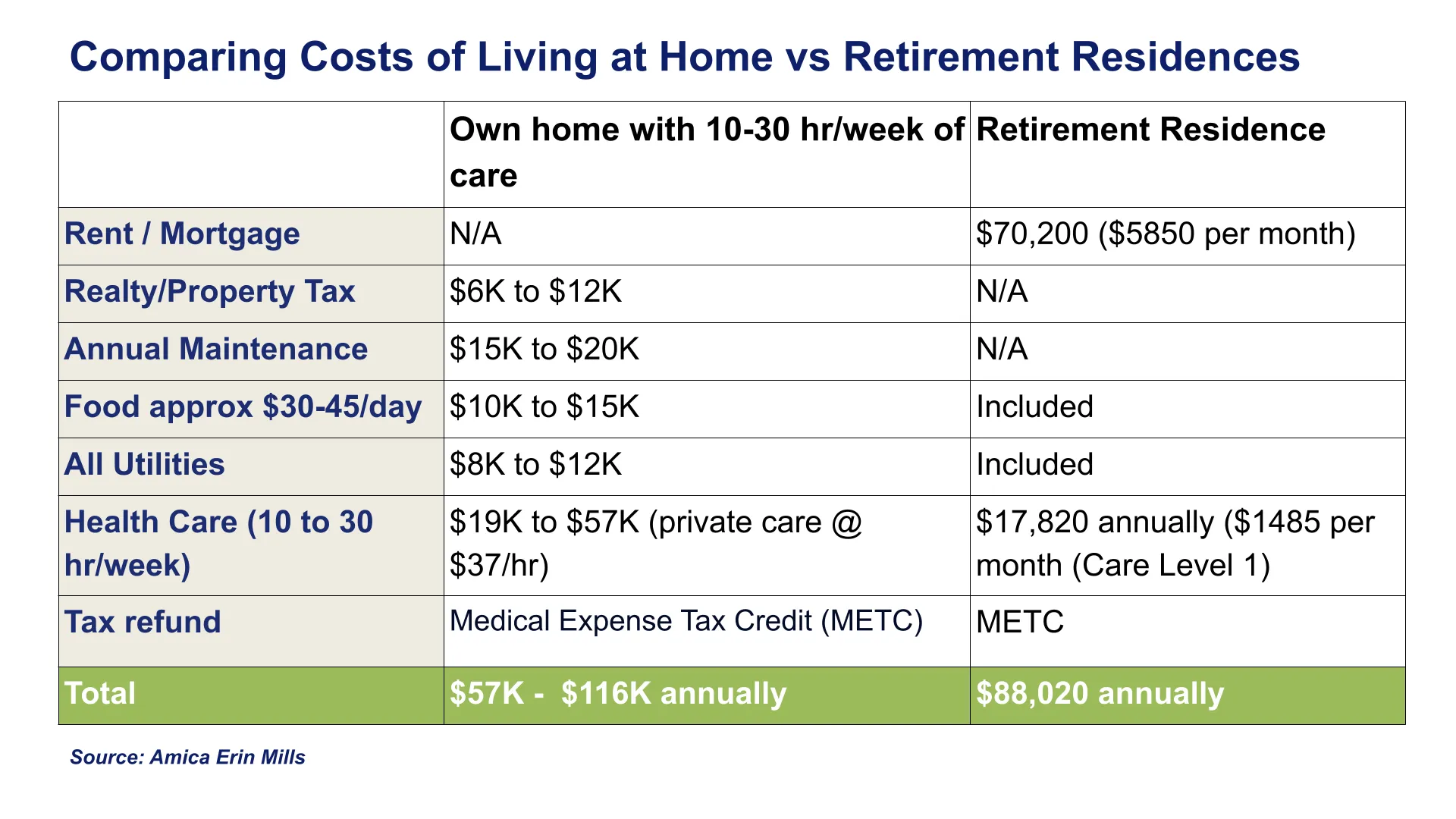
We did a webinar with Sonia Ohja from Amica Erin Mills and she provided the following chart to compare costs of living at home vs costs at a Retirement Residence. These numbers are directional and may be dfiferent based on region, needs etc..
Support does not have to mean full-time care.
Ontario-funded and community programs can include adult day programs, respite care, transportation, Meals on Wheels, friendly visiting, home maintenance and other community services. Some are publicly funded; others charge a modest fee.
A few particularly helpful places to start:
Parkinson Canada provides information specifically for people with Parkinson’s and their care partners, including local and virtual support groups and its CareFinder service. Its care-partner groups are free.
Website: Parkinson Canada
Ontario Caregiver Organization offers a free 24/7 helpline that can help caregivers find local programs, home-care options and other resources. Call 1-833-416-2273.
Website: Ontario Caregiver Organization
211 Ontario can help families locate local transportation, meals, senior services and community programs. Call or text 211.
Website: 211 Ontario
There may also be financial assistance. Ontario's Seniors Care at Home Tax Credit, for example, can provide eligible low- to moderate-income seniors with a refundable credit of up to $1,500 for qualifying medical expenses, including certain attendant-care expenses.
If you're helping a parent with Parkinson’s, it can feel as though you have suddenly taken on a second job—researching care, attending appointments, checking the house, managing emergencies and worrying about what happens next.
And you're often doing all of this while managing your own career, children and responsibilities.
We hear similar concerns from adult children regularly: Am I doing enough? When should I step in? How do I help without taking away my parent's independence?
You do not have to become your parent's PSW, care coordinator, driver, housekeeper and housing expert all at once.
Getting outside help isn't abandoning your responsibility. In many cases, it is what allows you to remain a supportive son or daughter instead of becoming completely consumed by caregiving.
Start before there is a crisis. Arrange an Ontario Health atHome assessment. Talk to Parkinson Canada. Explore respite care. Tour a few retirement residences—even if a move isn't imminent.

Parkinson’s progresses differently for every person. For one family, the best solution may be several hours of support at home. For another, it may eventually be a retirement residence offering meals, personal care and a safer environment.
The goal isn't necessarily to make a major change today. It's to understand your options before you desperately need them.
If housing is becoming part of that conversation, Seamless Rightsizing helps older adults and their families explore senior-friendly housing options and manage the practical and emotional steps of a move—from sorting and preparing the home through moving and settling in.
Sometimes the most helpful first step is simply understanding what support is available.
If you’d like guidance on navigating this situation, we’re here to help.
Get in touch at info@SeamlessRightsizing.ca or call 416-659-6011 for a free, no-pressure consultation.